A container of quartz slabs represents serious money, and the material is fragile, heavy, and sensitive to specification. One weak decision before you pay a deposit can turn a profitable project into a loss. Sound checks protect your budget and your delivery schedule.
Experienced buyers check before ordering in a fixed sequence. You confirm the China quartz slab supplier is legitimate, inspect product quality and batch consistency, verify compliance, review shipping and payment terms, then calculate landed cost. Each step builds on the last.
Treat this guide as a practical due-diligence path. Work through every checkpoint before you commit funds for quartz slabs from China, and you reduce risk at the source rather than after the container arrives.
Key Takeaways
-
Verify the supplier is a real factory with valid licenses and certifications.
-
Inspect product quality and batch consistency before you pay.
-
Confirm all compliance documents match your destination country's rules.
-
Review shipping and payment terms to protect your money and goods.
-
Calculate the total landed cost, including freight and hidden fees.
Verify Supplier Legitimacy
Supplier legitimacy is the first checkpoint on any due-diligence list. A credible China quartz slab supplier protects your deposit, your specification, and your delivery date. A weak one exposes all three.
What Buyers Check Before Ordering: Credentials
Start with the business license. Confirm the legal company name, registration number, business scope, and registered address. The scope should cover stone manufacturing or processing, not only trading. Cross-check the address against the factory location on a map. A commercial office building instead of an industrial zone deserves a question.
Certifications come next. Ask for current certificates and verify each one on the issuing body's website. Check the scope wording too. A certificate that lists trading rather than manufacturing tells you something important. The table below shows the credentials a serious quartz slab factory typically holds.
| Certification / Credential | What It Confirms |
|---|---|
| ISO 9001 | Quality management system |
| ISO 14001 | Environmental management system |
| ISO 45001 | Occupational health and safety system |
| NSF/ANSI 51 | Food equipment material safety |
| CE marking (via SGS) | Compliance for EU market access |
| SGS and BV factory audits | Independent third-party verification |
| Greenguard Gold | Low indoor air emissions |
Buyers check before ordering on Alibaba as well. Read the transaction history, response rate, and customer reviews. Look for repeat buyers and verified supplier status. Reviews reveal how a supplier handles problems, which matters more than a perfect rating. Request a short video walkthrough of the production floor and packing area. A supplier with nothing to hide will send one promptly.
Spotting Trading Companies vs. Factories
Trading companies are not automatically a problem. The real risk is unclear production responsibility. You need to know who produces the slabs, who controls the approved specification, who signs off QC, and who answers when the order does not match. Ask these questions on your first video call:
-
Which legal entity signs the proforma invoice and receives payment?
-
Which facility produces this SKU, and can you show the line, warehouse, and packing area?
-
Who approves color, dimensions, QC records, and shipment release?
-
If production moves to another facility, how will you inform me and re-approve the product?
Watch for specific red flags. A supplier claims any finish in ten days, yet a genuine factory cannot switch lines overnight. A supplier refuses to show the loading dock or allow an audit. The business license address points to a commercial building. The ISO certificate reads "trading of ceramic tiles" rather than manufacturing. Reluctance to permit a third-party audit is another warning sign. So is a business scope that lists consulting or import-export services only.
If the beneficiary name on the bank account is different from the company name on the PI, do not send money. Legitimate factories use company bank accounts that match their business registration.
Finally, confirm practical capability. Ask for actual slab photos or videos, fabrication capacity, CAD support, dry-lay inspection, packaging standards, and export coordination. A supplier with its own facilities, such as MRD STONE in Nan'an with ISO9001, NSF, BV, and SGS credentials, can control these steps directly. Ask for the name of the person who owns QC release, and confirm that name appears on your inspection report. Buyers check before ordering at this stage, and the answers separate a real quartz slab factory from a middleman.
You can also review the MRD STONE factory and company profile to learn more about its manufacturing background and production capabilities.
Check Product Quality
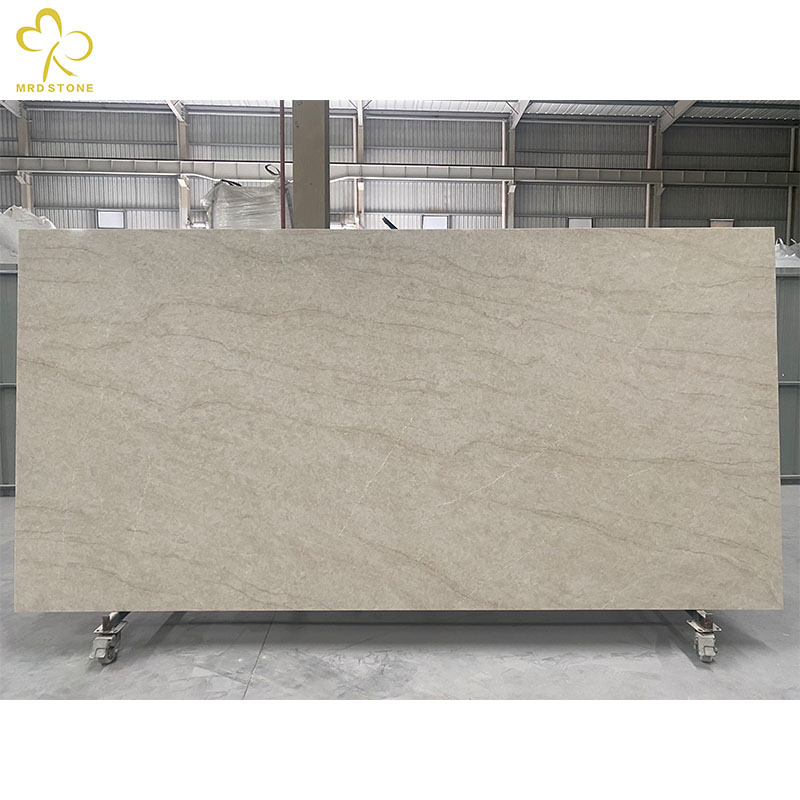
Photos and small samples cannot capture the full beauty and variation of quartz. Screens, lighting, photography, and image size all change how a slab appears. A product photo may show the general pattern, but it may not show full scale, undertone, depth, or finish accurately. Seeing the slab in person gives a better sense of color, movement, and reflection, and lets you compare it with cabinet, flooring, tile, or paint samples. Keep these limits in mind:
-
Scale matters. A sweeping vein may look elegant on a full slab but disappear on a small vanity.
-
Do not judge from one corner. Patterns vary across the slab, especially with dramatic movement.
-
Lighting shifts color. Warm bulbs, cool bulbs, and daylight all change how a white reads.
-
Compare side by side. Differences between similar patterns become obvious in person.
Inspect every slab in person before you cut or finalize selection. This step protects you more than any brochure.
Samples, Specs, and Test Reports
Request technical data sheets and recent test reports for the exact product you plan to buy. Ask for water absorption, flexural strength, abrasion resistance, stain resistance, and heat guidance. Reports from accredited laboratories carry more weight than attractive brochures, yet a certificate may cover only selected colors or batches. Confirm the report matches your material type, specification, and testing method. For high-value orders, independent laboratory testing adds verification.
Thickness deserves special attention. A slab sold as 3 cm may arrive thinner. Actual thickness can vary by product, color, and manufacturing specification. Ask for the actual tolerance range, not a general quality claim. Confirm the acceptable thickness range in writing before production and include it in the inspection criteria.
Chinese quartz commonly contains about 49% rock mixed with glass. Different products tend to perform similarly in durability, so verify specs rather than assume.
Batch Consistency and Slab Inspection
Order slabs from the same production run when visual uniformity matters. Ensure that the supplier can provide quartz slabs that come from the same batch or at least ensure color and texture consistency.
For large projects, negotiate a pre-production approval process:
-
Sign off on slabs from the same production run.
-
Request slab photos with batch numbers.
-
Confirm vein matching where required.
-
Consider splitting shipment so one space draws from one batch.
Leading factories now use high-resolution slab scanning and batch image archiving, which gives buyers pre-shipment visibility. Then inspect each slab with raking light. Tilt the slab, dry the surface, and sweep a flashlight nearly parallel to the face. Mark any linear shadow with tape, drag a nail across it, and apply hand pressure to test for flex. A true open fissure catches your nail; a surface scratch or vein color change will not. Check the back face too.
| Check | Key Point |
|---|---|
| Product | Confirm material, code, and specification |
| Color | Verify variation within the agreed range |
| Dimensions | Measure size, thickness, and flatness |
| Surface | Check polish, stains, scratches, chips |
| Documents | Confirm reports and specifications |
A reliable quartz slab factory traces each slab to a batch and inspection date. Ask your China quartz slab supplier for that record before loading.
When comparing colors and patterns, buyers can also review the MRD STONE quartz slab collection to understand the available slab styles and product options.

Confirm Compliance
Compliance protects your shipment at the border and your reputation after installation. Confirm the paperwork before you pay, not after the vessel sails.
Safety and Environmental Certifications
Request the certificates that match your market and application. A China quartz slab supplier should provide current copies without delay. Common documents include SGS test reports, CE certificates, and RoHS certificates. NSF, ISO, and Greenguard credentials may also be relevant depending on the product and its intended use. For public and commercial bids, ask for ISO-17025 silica certificates. Sustainability-minded developers may request ISO-14067-audited data and other documentation covering the product's environmental impact.
Verify each certificate rather than trust the PDF. Follow these steps:
-
Ask for copies with current validity dates.
-
Check the holder on the issuer's official database. NSF maintains a searchable listing of certified products, and UL's Greenguard database lists certified products.
-
Request utility bills or third-party audit reports covering energy and water use.
-
Confirm whether an international buyer or certification body has audited the factory.
-
Ask for waste recycling records and the share of waste reprocessed.
-
Visit the quartz slab factory to observe dust collection, water treatment, and waste management firsthand.
| Certification | What It Verifies |
|---|---|
| NSF/ANSI 51 | Food contact safety for commercial food equipment |
| Greenguard Gold | Low chemical emissions for indoor air quality |
| ISO 14001 | Environmental management system in place |
| CE Marking | EU regulatory compliance for applicable products |
Destination Import Requirements
Every destination sets its own entry rules. For the United States, a standard quartz import requires a commercial invoice, packing list, ocean bill of lading, and certificate of origin. Most shipments also need a customs bond and an Importer Security Filing, commonly called "10+2," filed at least 24 hours before the vessel loads. California-bound goods may need Proposition 65 information.
For the European Union, CE marking may apply to relevant construction products under the applicable standards, and wooden packaging must carry ISPM-15 treatment and marking. Confirm the applicable import standards with your customs broker and match every document to the invoice before shipment.
Review Shipping and Payment
Shipping and payment terms decide who carries risk when something goes wrong. Review both before you release funds for quartz slabs from China.
Crating, Loading, and Shipping Terms
Quartz is dense and brittle, so packing quality directly affects your damage rate. Match slab format to the container's internal dimensions rather than theoretical pallet counts, and avoid dead space that raises freight cost per slab and lets material shift in transit. Confirm gross weight before booking, because overloaded containers create port problems.
Ask your China quartz slab supplier to document each packing stage. A sound sequence runs like this:
-
Inspect every slab for cracks, chips, and stains, and verify dimensions, thickness, and polish against the order.
-
Clean the surface and apply a protective wax coating.
-
Label each slab with a barcode sticker for tracking.
-
Wrap slabs in plastic film with foam or cardboard between them.
-
Line crates with shock-absorbing padding.
-
Crate slabs on fumigated wooden pallets reinforced with straps, corner protectors, and edge guards.
-
Load pallets with forklifts, leaving space between pallets and container walls, and stabilize with wooden blocks or wedges.
Wooden crates must meet ISPM-15 fumigation rules. Before the container ships, hire a third-party inspector such as SGS to verify dimensions, surface defects, color consistency, and packaging integrity. Approve packing photos before loading and keep loading-sequence photos as shipment records.

Payment Methods and Contract Terms
Normalize every quotation before you compare price. Fix the variables first: slab dimensions, thickness, finish, pattern, quantity, packaging, quality requirements, and delivery terms. A professional RFQ states the quartz type, color reference, application, project location, and delivery schedule.
Build risk controls into the contract. Agree inspection criteria before shipment rather than after a dispute, and specify thickness tolerance rather than nominal thickness alone. Tie payment milestones to documented inspection results, and confirm the beneficiary name matches the company on the proforma invoice. Evaluate suppliers on reliability and orientation, not price alone—a responsive quartz slab factory that supports repeat orders protects your long-term supply.
If your project requires finished surfaces as well as raw slabs, compare the available quartz countertop products and confirm the required dimensions, finish, and fabrication specifications before placing an order.
Calculate Landed Cost
Hidden Costs Beyond Unit Price
The unit price on a quotation covers only part of your journey. Freight, import duty, insurance, port fees, inland transport, and damage risk all add to the final bill. Slabs are heavy, they travel upright, and they ship in wooden A-frame bundles. That makes freight a first-order term in the true cost, not an afterthought. The weight of each slab depends on its length, width, thickness, and material density. Slab loads tend to cube out on weight rather than volume, so weight sets how many sheets fit in a container. That figure, not the sheet price, ultimately sets freight per square foot.
Leaving freight out until the end is a common mistake. On heavy slab loads, delivered cost can move more between two suppliers than the sheet price does. Get the landed number early, while you can still change the loading plan. Damage risk belongs in the same calculation. Budget for a small allowance against breakage, and confirm who carries that risk at each stage.
Quotation Comparison and Budget Buffer
Incoterms decide which part of the journey sits inside the quotation. Pitting an ex-works figure against a CIF figure is not a comparison of suppliers; it is a comparison of terms. Ask for the term in writing, then convert both quotations to the same one before reading anything into a price difference.
| Term | What the supplier's price covers | What the buyer still pays |
|---|---|---|
| EXW | Packing and loading at the factory gate | Inland haulage, export clearance, ocean freight, duty, delivery |
| FOB | Packing, inland haulage, export clearance, loading on board | Ocean freight, insurance, import duty, final delivery |
| CIF | Everything in FOB plus ocean freight and insurance | Import duty, port charges at destination, final delivery |
| DDP | The whole journey, including duty and delivery to site | Nothing beyond the agreed price and local unloading |
Normalize the rest of the quote before you compare. Confirm both quotes cover the same format and thickness, the same unit, and the same packing. Check MOQ and color-mixing rules, lead time, payment terms, claims and color tolerance, and whether certification and test reports are included or charged separately. Then build a budget buffer for the costs you cannot fix in advance. Finally, choose a fabricator experienced with quartz slabs from China. Fabrication and installation affect the final result as much as the slab itself, and a capable China quartz slab supplier will support that handoff.
For buyers comparing engineered stone options, MRD STONE also offers an artificial quartz stone slab collection with different colors and surface styles for countertop and interior applications.
Run through the full checklist one last time. Confirm a verified supplier, a tested and consistent product, documented compliance, solid shipping and payment terms, and a realistic landed cost. Each item protects the next.
The core rule stays simple. Inspect your slabs and verify every document before you release a deposit or place the full order. Buyers Check Before Ordering quartz slabs from China carry far less risk than those who learn on arrival. Thorough checks now protect both your budget and your project timeline.
FAQ
What is the minimum order for quartz slabs from China?
Most factories quote by container load, and a full container holds a fixed number of slabs. Smaller trial orders are sometimes possible but carry higher freight per slab. Ask your China quartz slab supplier for the MOQ in slabs and in square meters, then compare that figure against your actual project takeoff.
How long does production take?
Lead time depends on whether your color is in stock or made to order. Stock colors ship faster. Custom runs need scheduling time for pressing, polishing, and packing. Ask the quartz slab factory to confirm the lead time in writing on the proforma invoice, and add a buffer before your installation date.
Can I get samples before ordering?
Yes. Reputable suppliers send small samples, often free or at low cost, with freight paid by the buyer. Treat a sample as a color reference only. It cannot show full-slab movement or scale. Approve the actual production slabs before cutting, as the quality section explains.
When should I schedule third-party inspection?
Book inspection after packing and before the container leaves the factory. An inspector such as SGS can verify dimensions, surface defects, color consistency, and crating. Confirm the inspection date with your supplier early, because rescheduling near vessel cut-off adds cost and delay.
How do I protect my deposit?
Pay through a company bank account whose name matches the proforma invoice. Tie later payments to documented inspection results. Avoid personal accounts and unusual routing requests. A supplier who resists these terms is telling you something useful before your money moves.